
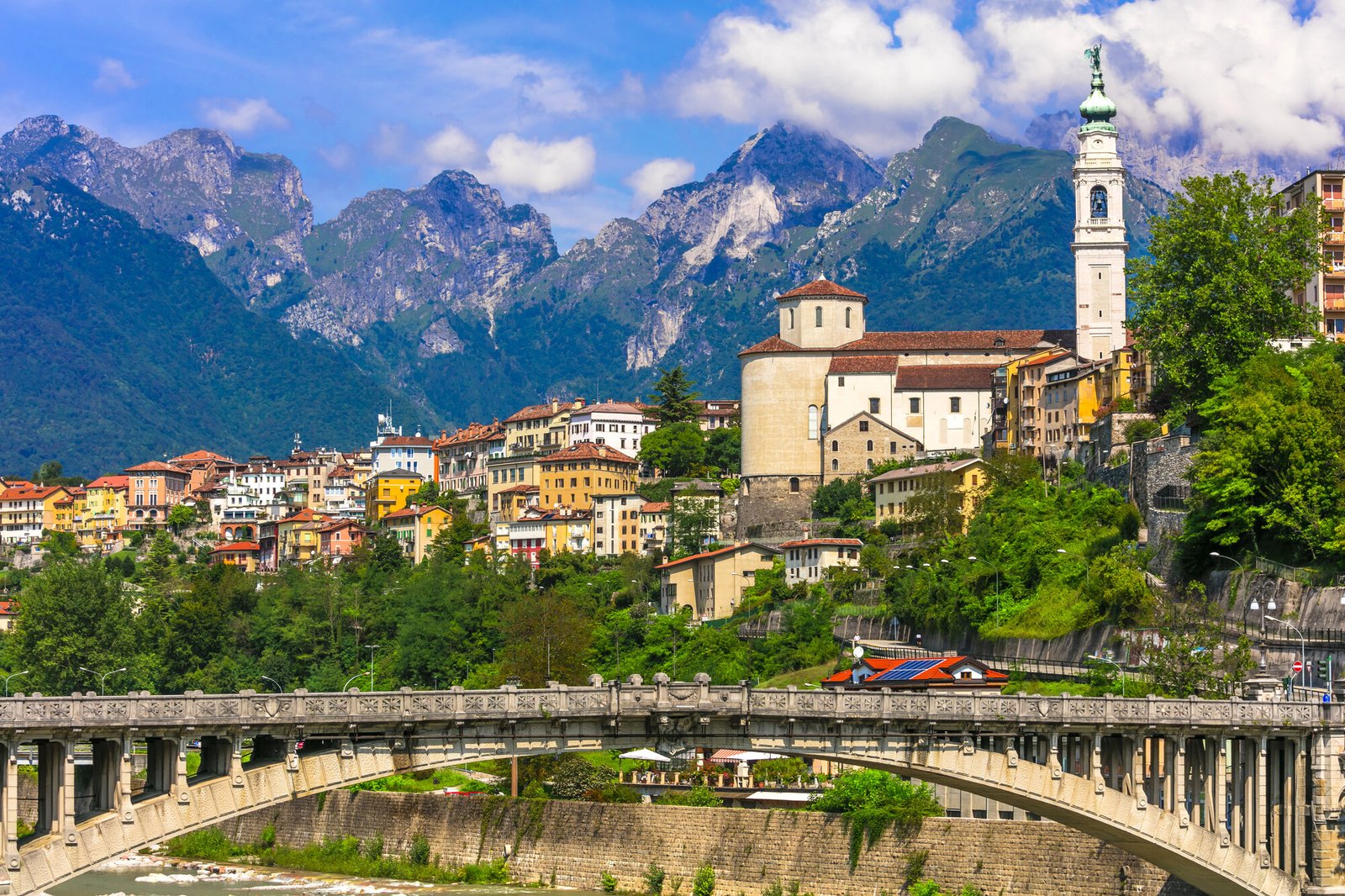
Veneto · Belluno · Italy
Belluno
Gateway to the Dolomites, offering a mix of outdoor activities, cultural heritage in medieval setting, and a blend of traditional and modern industries. Ideal for nature lovers and history enthusiasts.
At a glance
About Belluno
Belluno is a picturesque municipality located in the northern region of Veneto, Italy. The town is strategically positioned as the gateway to the Dolomites, a UNESCO World Heritage site, offering easy access to breathtaking mountain landscapes and a variety of outdoor activities.
As an economic hub, Belluno supports different industries, including traditional manufacturing and modern services. Its historical centre, characterised by medieval architecture, shows us the richness of its cultural heritage, which is still present today.
The town is also an administrative and commercial epicentre for the surrounding mountain communities. The educational facilities are available for a diverse student population, while local transportation infrastructure connects it effectively with major cities and neighbouring regions.
✓ Pros for expats
– High-quality healthcare services available for residents.
– Excellent air quality, promoting a healthy lifestyle.
– Low unemployment rate, ensuring economic stability.
– Well-connected transportation infrastructure for easy commuting.
– Rich cultural and historical heritage to explore.
– Opportunities for integration within the local community.
– Mild climate, ideal for outdoor activities year-round.
– Access to quality educational facilities for all ages.
– Limited tourist presence, preserving local charm and tranquility.
– Strong internet connectivity for remote work and communication.
! Things to consider
– Limited entertainment options for nightlife enthusiasts.
– Smaller expat community may feel isolating at times.
– Public transport frequency can be sporadic during off-peak hours.
– Local dialects may pose communication challenges for newcomers.
– Some historical buildings lack modern accessibility features.
– Weather can be too humid or chilly for some.
– Limited shopping options compared to larger cities.
– Cultural events may not be as frequent or diverse.
– Local cuisine might not satisfy all palates.
– Integration requires effort and patience in close-knit communities.
Where is Belluno
Getting there
Belluno, located in the Veneto region, offers reasonable connectivity. The nearest airports are Treviso and Venice, both approximately an hour away. The town is accessible via major road networks, including the SS51. Local train stations provide limited but adequate service to surrounding areas, with moderate connectivity scores.
Getting around
Belluno’s compact structure makes navigation on foot viable, supplemented by dependable local bus services. Taxis are available, while the proximity of the city to major roads facilitates easy entry by car. Parking is ample, ensuring convenience for both residents and visitors.
Housing & cost of living
Estimated cost of an 80 m² home: €95,760
Housing availability: High
Cost of living
Belluno offers a compelling choice for those considering relocation, with an affordability profile that reflects both stability and opportunity. With low unemployment and an attractive median income, residents can manage their living expenses comfortably. Housing prices are moderate, particularly for rentals in the suburbs, making it easier for families and individuals to settle down. The overall cost of living is aligned with the quality of life, indicating a healthy economy where expats and investors can thrive without excessive financial strain. Therefore, Belluno is a wise pick for a balanced lifestyle without breaking the bank.
Climate & weather
Very Low (Bottom 10%)
High (71st-80th percentile)
Very High (81st-90th percentile)
Low (11th-20th percentile)
Air quality & environment
Air quality rating: ★★★★★
Belluno, located in the picturesque settings of Italy, offers strikingly pure air, making it an inviting option for those considering relocation or retirement. The town boasts commendable levels of PM10 and nitrogen dioxide; both metrics fall within good classifications, suggesting a minimal presence of these pollutants. Although PM2.5 and ozone levels are slightly higher, positioned in the fair category, they still compare favorably to many other regions. Sulphur dioxide is exceptionally low, adding to the overall appeal of Belluno's atmosphere. This balanced profile ensures that residents can enjoy the natural beauty without undue concern about air quality.
Healthcare & safety
Road accidents: 31.0 per 10k inhabitants.
ULSS 1 Dolomiti covers Belluno province — Belluno itself, Feltre, Cortina d’Ampezzo, the Cadore, the Agordino. Composite of 48/100, just below the national median. The data is best read alongside the geography: 1-year stroke survival is in the national top decile, while 30-day STEMI survival is the weakest in Italy. Stroke patients who reach hospital do well in Veneto’s rehabilitation network, but acute STEMI is unforgiving of long mountain drives to a catheter lab. Residents with cardiovascular risk should plan for likely transfer to Treviso or Padova for acute cardiac care; stroke recovery and chronic management are well-handled locally.
Internet & connectivity
Transport & proximity
✈️ Airports
| Airport | Drive | Score |
|---|---|---|
| Antonio Canova (Treviso) | 48 min | 7 |
| Marco Polo (Venice) | 50 min | 8 |
| Friuli Venezia Giulia (Trieste) | 79 min | 7 |
🚂 Rail stations
| Station | Drive | Score |
|---|---|---|
| Belluno | 3 min | 7 |
| Santa Croce del Lago | 18 min | 7 |
| Ponte nelle Alpi-Polpet | 11 min | 6 |
What's nearby
Life in Belluno
What to see & do
- Piazza del Duomo: The heart of Belluno, featuring the beautiful Cathedral of San Martino and the Palazzo dei Rettori.
- Museo Civico: Museum showcasing the history and art of Belluno, housed in the historical Palazzo Fulcis.
- Chiesa di San Rocco: Stunning church known for its frescoes.
- Palazzo dei Vescovi: Historical palace that now serves as a diocesan museum.
- Ponte degli Alpini: Scenic bridge offering stunning views of the Piave River and surrounding mountains.
- Chiesa di Santo Stefano: Gothic church with a rich collection of Renaissance artworks.
- Parco Nazionale delle Dolomiti Bellunesi: Natural park offering hiking, wildlife watching, and mountain views.
- Villa Buzzati: The former home of writer Dino Buzzati, now a museum dedicated to his life and works.
- Porta Rugo: A medieval gate that once served as the main entrance to the city.
- Basilica Santuario dei Santi Vittore e Corona: Basilica has panoramic views and is a peaceful retreat.
Neighbourhoods
– **Baldenich**: A residential area located close to the town centre, offering various housing options and essential amenities.
– **Bersaglio**: A mostly residential neighbourhood featuring local shops and services.
– **Borgo Garibaldi**: Known for its strategic position near transport links and offering a mix of residential and commercial properties.
– **Borgo Piave**: Located near the river, this area includes both residential spaces and local businesses.
– **Borgo Prà**: Offers residential living with access to nearby local shops and community facilities.
– **Cavarzano**: A residential district situated on the outskirts with community services and scenic views.
– **Col di Piana**: Primarily residential with a quieter suburban environment.
– **Lambioi**: Known for its residential homes and close-knit community ambiance.
– **Mussoi**: Features residential buildings with convenient access to nearby markets and shops.
– **Nogaré**: A residential area that provides a range of housing options for locals and newcomers alike.
– **Centro Storico**: The historical centre, rich in cultural landmarks and offering a blend of residential and retail spaces.
Local cuisine
Belluno’s culinary scene is characterized by its rich traditional dishes, prominently featuring casunziei (half-moon-shaped ravioli), pastin (a specialty sausage), and various cheeses like Schiz and Piave. The cuisine reflects a heavy use of meat and cheese, drawing on local alpine influences and fresh ingredients from the surrounding mountains. The international dining options in Belluno include styles that incorporate Austrian influences due to its proximity to the border, as well as a variety of regional dishes that creatively utilize polenta and fresh lake fish. Notably, Belluno is home to Michelin-starred restaurants such as Locanda San Lorenzo and Dolada, which showcase the region’s culinary talents with an emphasis on quality and innovation.
Where to shop
The region features a blend of retail formats including supermarkets offering fresh produce, organic items, and local specialties. Smaller artisanal shops provide unique handcrafted products. Weekly markets highlight regional delicacies and traditional goods. Shopping centres, while limited, encompass a few larger retail spaces. Boutique stores cater to niche interests, enhancing the shopping landscape. Overall, the area provides essential and specialty shopping experiences, supporting both daily needs and unique regional finds.
Green areas & parks
Belluno offers an array of outdoor activities and green areas, focusing mainly on hiking and exploration of the Dolomites. Noteworthy trails include the “Alta Via 1 Dolomites” and “Monte Serva via Col di Roanza.” For those interested in varied hiking experiences, “Bosco delle Castagne” and “Bortot Houses – Bus del Busón” present accessible options. The Dolomiti Bellunesi National Park stands out with its numerous hiking paths, forest roads, and via ferratas, appealing to nature enthusiasts. Exploring Lake Misurina, renowned as the ‘Pearl of the Dolomites,’ offers breathtaking views of the Tre Cime di Lavaredo.
Education
People & tourism
Frequently asked questions
### What is the cost of living in Belluno for expats?
The cost of living in Belluno is generally affordable compared to other Italian cities. An individual can expect to spend around €2,272 per month, while a family of four may need approximately €3,368. Rental prices for a one-bedroom apartment in the city center are about €650, and around €475 outside the center. Overall, Belluno is 3.9% more expensive than the Italian average, but still offers a good quality of life.