Living in Bologna: Cost, Community and Daily Life for Expats in 2026
Table of Contents
- What Bologna Actually Costs
- Why Bologna Works So Well Day to Day
- Transport Connections
- The University Influence
- Salaries and Local Job Market
- Who Bologna Suits
- Frequently Asked Questions
- Is Bologna cheaper than Rome or Milan?
- Is Bologna a good base for traveling around Italy?
- What’s the average rent for a one-bedroom apartment in Bologna?
- Does Bologna have a large expat community?
- Considering Bologna Seriously
Bologna rarely tops “best places to live in Italy” lists the way Florence or Rome do, and that’s precisely part of its appeal. It’s a genuinely functional, walkable, food-obsessed university city that consistently rents and costs 30-40% less than Milan or Rome, while offering a level of daily livability that both larger cities struggle to match.
What Bologna Actually Costs
A single person living in Bologna can expect total monthly costs, excluding rent, in the range of roughly EUR 850-1,130, depending on lifestyle, based on cost-of-living data compiled by comparison services and cross-referenced against Istat, Italy’s national statistics agency. Including rent, overall monthly budgets commonly land between EUR 1,600 and 2,400 for a single professional, meaningfully below Milan’s EUR 1,800-2,800 range for a comparable lifestyle.
| Expense | Typical Monthly Cost |
|---|---|
| One-bedroom apartment, city center | Roughly EUR 800-950 |
| One-bedroom apartment, outside center | Roughly EUR 650-750 |
| Utilities (two-bedroom apartment) | Around EUR 200-210 |
| Internet | Around EUR 35-40 |
| Monthly public transport pass | Around EUR 35 |
Why Bologna Works So Well Day to Day
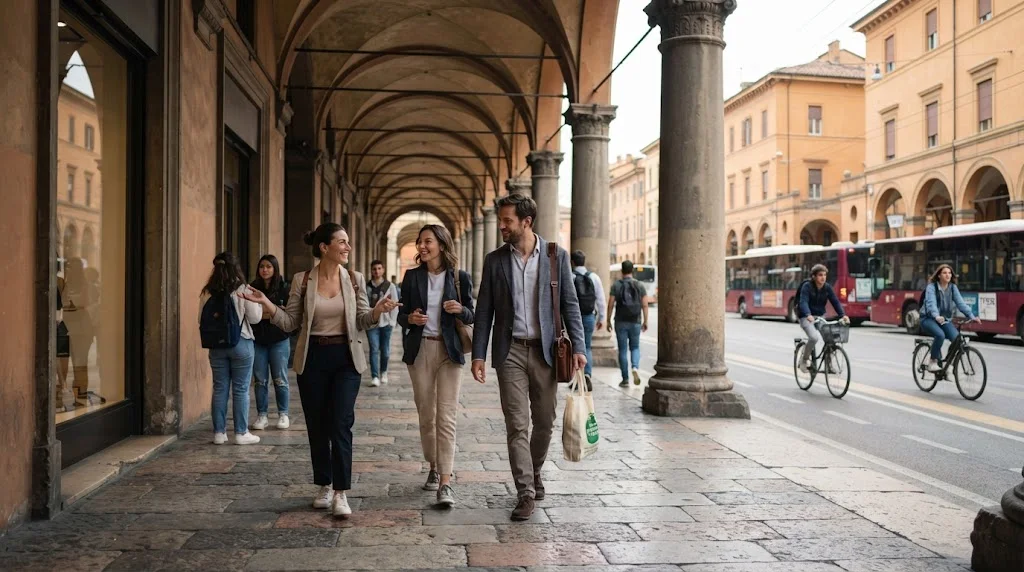
Bologna is flat, compact and built around roughly 40 kilometers of covered porticoes, a UNESCO World Heritage-listed feature since 2021, listed in full on UNESCO’s World Heritage list, that let residents walk across large parts of the city without exposure to rain, a genuinely practical advantage in a country where public transport doesn’t always run on the schedule you’d hope for. The city is highly bikeable, with widespread cycle infrastructure and bike ownership common among residents.
Transport Connections
Bologna Centrale is one of Italy’s busiest rail junctions, with high-speed Frecciarossa services connecting directly to Milan, Florence, Rome and Naples, making Bologna a genuinely practical base for anyone who needs to travel around Italy regularly without owning a car. The city’s public bus network, run by TPER, covers the city and surrounding municipalities comprehensively.
The University Influence
Home to the University of Bologna, founded in 1088 and recognized as the oldest university in the Western world, roughly a third of the city’s population is connected to student life in some form. This drives a genuinely international, youthful energy and a level of casual English proficiency among younger residents that’s less consistent in smaller Italian towns, though it also keeps the rental market competitive, particularly around the university district.
Salaries and Local Job Market
The average net monthly salary in Bologna sits around EUR 1,900-1,930, broadly in line with other major northern Italian cities and comfortably enough to support a comfortable lifestyle at local cost-of-living levels. The city has a diversified economy beyond the university itself, including manufacturing, food production, and a growing tech and startup scene.
Who Bologna Suits
Bologna tends to suit people who want genuine Italian city life, strong food culture, walkability, real cultural depth, without Milan’s higher costs or intensity, or Rome’s scale and tourist density. It’s a particularly strong fit for remote workers and freelancers who need reliable transport connections to the rest of Italy and Europe without needing to live in the country’s most expensive city to get them.
Read Also: North vs South Italy for Expats: Cost, Climate and Culture Compared Honestly
Frequently Asked Questions
Is Bologna cheaper than Rome or Milan?
Yes, meaningfully so, commonly cited as 30-40% cheaper than Milan for comparable rent and lifestyle, and generally cheaper than Rome as well, particularly outside the most central neighborhoods.
Is Bologna a good base for traveling around Italy?
Yes, Bologna Centrale’s high-speed rail connections to Milan, Florence, Rome and Naples make it one of the most practically connected mid-sized cities in the country.
What’s the average rent for a one-bedroom apartment in Bologna?
Roughly EUR 650-950 depending on the specific neighborhood, with city-center locations at the higher end of that range.
Does Bologna have a large expat community?
It has a substantial international student population and a growing professional expat presence, though it’s less of an established retiree-focused expat hub compared to regions like Tuscany or Puglia.
Considering Bologna Seriously
If your priorities are walkability, food culture, genuine Italian city life and strong rail connectivity, without Milan-level costs, Bologna deserves more attention than it typically gets in expat relocation conversations. It’s a city that rewards residents rather than performing primarily for tourists, which is exactly why it consistently ranks well on livability while staying comparatively under the radar.
%%SSILMASK14%%