Living in Puglia: The Honest Expat Guide to Cost, Healthcare and Community (2026)
Table of Contents
- What Puglia Actually Costs
- Coastal vs Inland: A Real Trade-Off
- Owning a Car: A Genuine Cost Consideration
- Healthcare in Puglia
- The 7% Flat Tax in Puglia
- Traditional Architecture: Trulli and Masserie
- Building Community in Puglia
- Frequently Asked Questions
- Is Puglia affordable compared to the rest of Italy?
- Do I need a car to live comfortably in Puglia?
- Does Puglia qualify for the 7% flat tax regime?
- Is healthcare good in Puglia?
- Climate in Puglia: Long, Genuine Summers
- Deciding If Puglia Fits Your Priorities
Puglia has become one of the most searched Italian regions among foreign buyers in recent years, and unlike some regions whose popularity outpaces their actual livability, Puglia largely earns the attention. It combines genuinely low costs, a real mix of coastal and inland living, and a growing but still manageable expat presence, though the honest picture involves real trade-offs worth understanding before committing.
What Puglia Actually Costs
A single person can live comfortably in Puglia’s smaller cities and towns on a monthly budget starting around EUR 950-1,500, including rent, meaningfully below what the same lifestyle would cost in Milan, Rome or even Florence, per current regional cost comparisons tracked by Idealista, one of Italy’s principal property portals. Lecce specifically, often called the “Florence of the South” for its baroque architecture, offers a particularly strong combination of cultural depth and modest living costs relative to its appeal.
| Expense | Typical Monthly Cost |
|---|---|
| One-bedroom apartment rent | EUR 400-1,000, varying significantly by town and coastal proximity |
| Groceries (single person) | Genuinely affordable, particularly fresh produce and seafood at local markets |
| Overall single-person budget | EUR 950-1,500 including rent, depending on lifestyle and specific town |
Coastal vs Inland: A Real Trade-Off
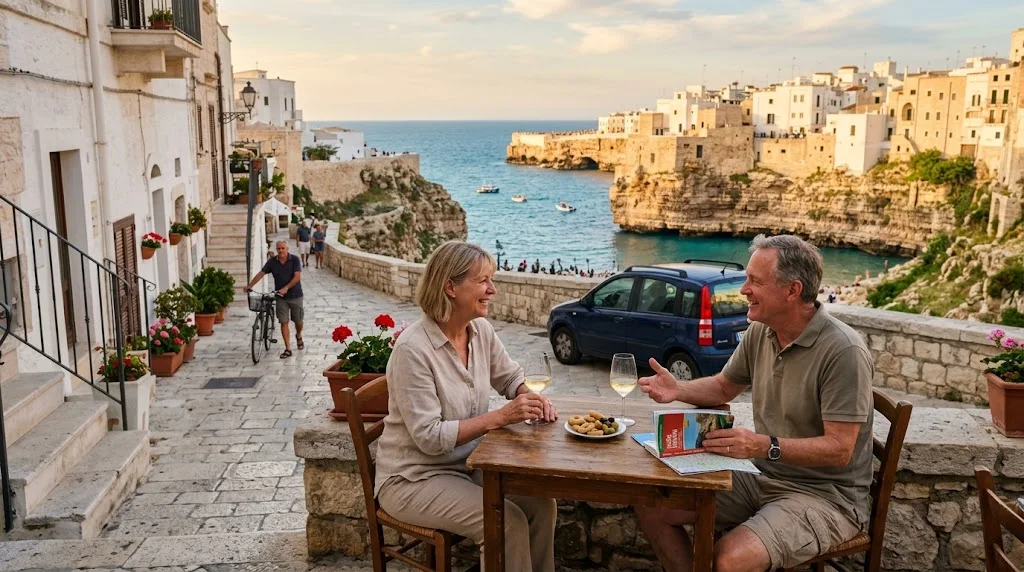
Puglia’s coastal towns, Ostuni, Polignano a Mare, Otranto, command genuine premiums over the region’s inland towns, reflecting both tourism demand and the coastal lifestyle appeal. Inland towns and smaller comuni offer meaningfully lower costs and a quieter, more year-round-resident character, without the seasonal tourism intensity that defines much of the coast during summer months specifically. Buyers and renters prioritizing value over beachfront proximity generally find significantly more property and living space for their budget by looking even 15-20 minutes inland from the region’s most photographed coastal towns, a pattern that holds fairly consistently across the whole region.
Owning a Car: A Genuine Cost Consideration
Public transport in Puglia, while functional in larger towns, doesn’t match the density or reliability of Italy’s northern cities, and many residents find a car genuinely necessary for daily life, particularly outside the largest towns. Car ownership costs, insurance, maintenance, fuel, are worth budgeting realistically as an ongoing expense rather than an occasional convenience, since relying purely on public transport or a bicycle, while possible in some towns, requires a lifestyle adjustment many newcomers underestimate. Ridesharing and taxi availability also thins out considerably once you’re away from Bari and the larger coastal towns, another reason most long-term Puglia residents ultimately conclude that car ownership isn’t optional so much as a basic prerequisite for comfortable daily life in the region.
Healthcare in Puglia
Puglia’s healthcare system provides adequate routine care throughout the region, though specialist care and the strongest hospital facilities concentrate in Bari and, to a lesser extent, Lecce, meaning residents in smaller coastal or inland towns should factor in travel time for anything beyond routine appointments. This mirrors the broader Southern Italy healthcare pattern documented in national outcomes data, worth weighing honestly alongside the region’s genuine cost and lifestyle appeal.
The 7% Flat Tax in Puglia
Puglia is one of the eight regions eligible for Italy’s 7% flat tax regime for foreign retirees, and following the April 2026 expansion of the population threshold, a meaningfully larger share of the region’s towns now qualify, including well-known coastal destinations like Ostuni and Manduria that were previously excluded under the older, narrower population cap.
Traditional Architecture: Trulli and Masserie
Puglia’s iconic trulli, the conical-roofed stone dwellings concentrated particularly around Alberobello and the Itria Valley, and masserie, fortified farmhouse estates, represent some of the region’s most distinctive and increasingly sought-after property types. Genuine, well-restored examples command real premiums, while entry-level properties requiring substantial renovation remain more accessible for buyers willing to take on that project. Both property types also carry real practical considerations beyond their visual appeal, trulli in particular have distinctive structural quirks tied to their conical stone construction that a standard renovation contractor unfamiliar with the style may not fully anticipate, making specialized local expertise genuinely valuable for any restoration project.
Building Community in Puglia
Puglia’s expat community has grown substantially in recent years, particularly around Ostuni, Lecce, and coastal towns with established international appeal, offering meaningful social infrastructure for newcomers. Inland and smaller towns offer less ready-made expat community but generally deeper, faster integration into genuine local life for those willing to make the language and cultural effort. Regional demographic and economic data is compiled by Istat, Italy’s national statistics agency, useful for anyone wanting a broader statistical picture of the region beyond individual town anecdotes.
Read Also: Mental Health Care in Italy for Expats: Finding English-Speaking Therapists
Frequently Asked Questions
Is Puglia affordable compared to the rest of Italy?
Yes, genuinely so. Puglia consistently ranks among Italy’s more affordable regions for both property and overall cost of living, particularly compared to Milan, Rome, or Tuscany’s most sought-after areas.
Do I need a car to live comfortably in Puglia?
In most towns, yes. Public transport is functional in larger towns but doesn’t match northern Italy’s density, and many residents find a car genuinely necessary for daily life outside major towns.
Does Puglia qualify for the 7% flat tax regime?
Yes, and the region’s eligible town list expanded meaningfully after the April 2026 population threshold change, now including several well-known coastal towns previously excluded.
Is healthcare good in Puglia?
Routine care is generally adequate throughout the region, though specialist care concentrates in Bari and Lecce specifically, worth factoring in for residents settling in smaller or more remote towns.
Climate in Puglia: Long, Genuine Summers
Puglia’s climate runs meaningfully warmer and drier than central or northern Italy, with long, intensely hot summers, particularly inland, and mild, generally rain-heavier winters. This climate is part of the region’s core appeal for retirees and remote workers specifically seeking a genuinely Mediterranean lifestyle, though newcomers from cooler climates should realistically prepare for summer heat that extends well beyond what “warm Italian summer” might suggest in the abstract, sometimes running into the high 30s Celsius for extended stretches in July and August.
Deciding If Puglia Fits Your Priorities
Puglia rewards buyers and residents who value genuine value, a real mix of coastal and inland character, and a still-developing but increasingly established expat infrastructure. Weigh the car-dependency reality and the healthcare concentration in Bari and Lecce honestly against the region’s genuine cost and lifestyle advantages before choosing a specific town within it.
%%SSILMASK16%%