
No Tipping in Italy: Why It’s Not Expected and What to Do Instead
Table of Contents
- Why Tipping Isn’t Built Into Italian Service Culture
- What the Coperto and Servizio Charges Already Cover
- When Something Extra Is Genuinely Appropriate
- Bars and Cafes: Rounding, Not Percentage Tipping
- Why Over-Tipping Can Actually Feel Awkward
- Tipping in Different Regions
- How This Affects Long-Term Residents Specifically
- Frequently Asked Questions
- Is it rude not to tip in an Italian restaurant?
- Should I tip taxi drivers in Italy?
- Does the coperto charge replace tipping?
- Is tipping more expected in tourist cities than smaller towns?
- Letting Go of Home-Country Tipping Instincts
American visitors and new residents in particular carry a genuine, understandable anxiety about tipping in Italy, worried about causing offense either by tipping too little or by not tipping at all. The reality is considerably simpler than the anxiety suggests: Italy’s service industry operates on a fundamentally different compensation model, and understanding that model removes most of the guesswork entirely.
Why Tipping Isn’t Built Into Italian Service Culture
Unlike the US, where server wages are often legally structured around the assumption that tips will supplement a low base wage, Italian service workers are generally paid a standard wage that doesn’t depend on tips to reach a livable income, under employment protections set out through Italy’s national collective bargaining agreements (contratti collettivi nazionali). This structural difference is the root of everything else about Italian tipping norms: there’s no built-in expectation that a bill needs supplementing to fairly compensate the person who served you, because that compensation structure was never the model to begin with. Current guidance on standard restaurant billing practices, including the coperto, is published by Ministero delle Imprese e del Made in Italy, Italy’s Ministry of Enterprises.
What the Coperto and Servizio Charges Already Cover
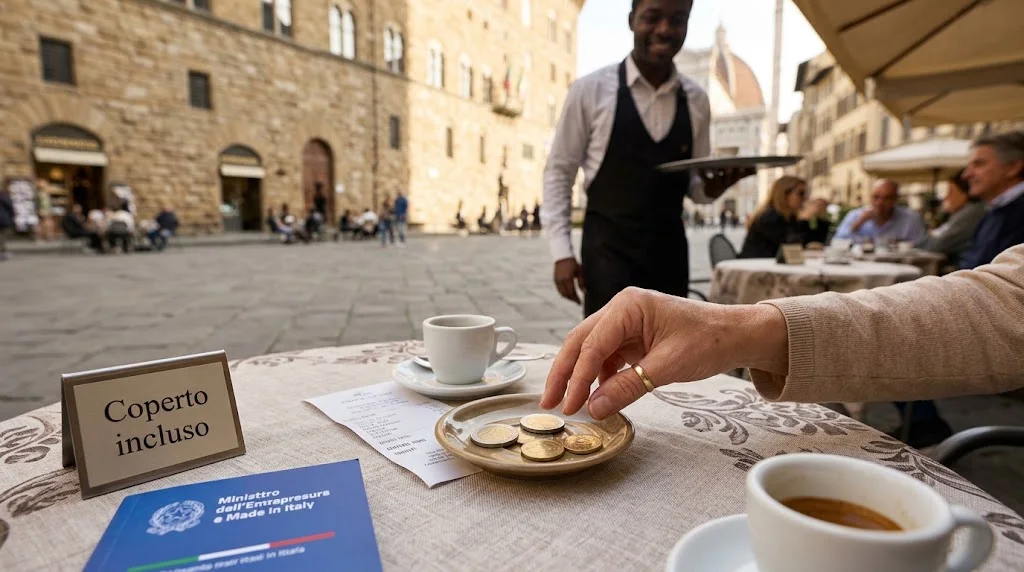
Most Italian restaurant bills include a coperto (cover charge), a small per-person fee covering bread and basic table service, and in some establishments, a separately itemized servizio (service charge), a percentage automatically added to the bill. Where a servizio charge is already itemized, this functions similarly to what a tip would accomplish elsewhere, meaning an additional tip on top genuinely isn’t expected or necessary.
When Something Extra Is Genuinely Appropriate
- Exceptional service at a restaurant without an itemized servizio charge, rounding up or leaving a few euros is a genuine, appreciated gesture, though still entirely optional rather than obligatory.
- Taxi drivers, rounding up to the nearest euro is common and appreciated, though not expected as a percentage the way US taxi tipping culture works.
- Hotel staff, particularly for porters handling luggage or exceptional concierge assistance, a small tip is a reasonable, appreciated gesture rather than a mandatory transaction.
- Tour guides, especially for private or small-group tours where the guide’s income more directly depends on client satisfaction, a tip is more commonly expected than in most other Italian service contexts.
None of these situations carry a fixed percentage expectation the way US tipping culture generally does; the amounts involved are modest and gesture-based rather than calculated as a proportion of the total bill.
Bars and Cafes: Rounding, Not Percentage Tipping
At a standard Italian bar or cafe, ordering a coffee at the counter, the concept of a percentage-based tip essentially doesn’t apply. Leaving small change, a few coins, is a common, low-key gesture some locals make, but it’s genuinely optional and far removed from the 15-20% expectation common in US coffee shop culture. Table service at a cafe, sitting down rather than standing at the counter, sometimes involves a different pricing structure entirely, worth checking the menu, since sitting can carry its own service premium built directly into the listed price rather than requiring a separate tip.
Why Over-Tipping Can Actually Feel Awkward
Because tipping isn’t structurally expected, an unusually large tip can occasionally create genuine confusion rather than pure appreciation, sometimes prompting a server to actively question whether you’ve made a mistake with the payment. This isn’t universal, and generous gestures are rarely taken badly, but it’s worth understanding that the instinct to significantly over-tip “to be safe,” common among American visitors specifically, doesn’t map onto local expectations the way it might feel intuitively correct to do.
Tipping in Different Regions
Tipping norms show some regional variation, generally slightly more common and expected in major tourist-heavy cities and higher-end establishments than in smaller towns, where the entire concept remains considerably more foreign to standard local practice. Rome, Florence, Venice and Milan’s more internationally oriented restaurants have, over years of heavy tourist traffic, developed somewhat more tolerance for and even mild expectation of small tips, while a neighborhood trattoria in a smaller southern town remains firmly in “not expected at all” territory. Regional and city-level tourism boards, coordinated nationally through Ministero della Cultura, Italy’s Ministry of Culture, occasionally publish visitor etiquette guidance that touches on these local variations for specific destinations.
How This Affects Long-Term Residents Specifically
For expats settling into Italy long-term, adjusting away from home-country tipping habits is usually one of the easier cultural transitions to make, mostly because it removes a source of daily mental calculation rather than adding one. Long-term residents consistently report that not tipping, once genuinely internalized as the local norm rather than something requiring constant deliberate resistance, becomes simply another unremarkable part of daily life within a matter of months.
Read Also: Living in Puglia: The Honest Expat Guide to Cost, Healthcare and Community (2026)
Frequently Asked Questions
Is it rude not to tip in an Italian restaurant?
No, not tipping is the standard, expected practice, particularly where a servizio charge is already itemized on the bill. Not tipping causes no offense whatsoever under normal circumstances.
Should I tip taxi drivers in Italy?
Rounding up to the nearest euro is common and appreciated, though not expected as a percentage-based tip the way it commonly is in the US.
Does the coperto charge replace tipping?
Partially, the coperto covers bread and basic table service specifically, while a separately itemized servizio charge, where present, more directly functions as the equivalent of a service tip.
Is tipping more expected in tourist cities than smaller towns?
Generally yes, major tourist cities and higher-end establishments have developed somewhat more tolerance for tipping through sustained international visitor exposure, while smaller towns remain firmly non-tipping in practice.
Letting Go of Home-Country Tipping Instincts
The single most useful mental shift for new arrivals is recognizing that Italian service workers aren’t relying on your tip to earn a fair wage, which removes the anxiety entirely and lets you focus on genuine appreciation for good service rather than obligatory calculation. When in doubt, rounding up modestly is always a safe, appreciated gesture; leaving nothing at all is equally, genuinely fine.
%%SSILMASK15%%