
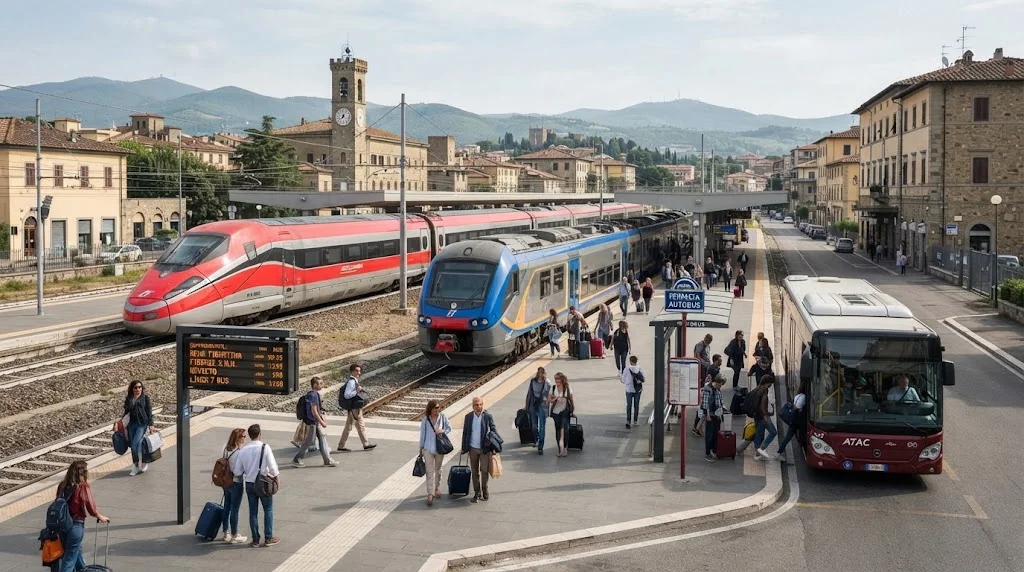
Public Transport in Italy: Trains, Buses and Getting Around Without a Car
Table of Contents
- The National Rail Network: Italy’s Genuine Strength
- Regional and Local Trains: A More Mixed Picture
- City Public Transport: Trams, Metros and Buses
- Where Car-Free Living Is Genuinely Realistic
- Where a Car Becomes Genuinely Necessary
- Buses: Filling the Gaps Trains Don’t Cover
- Ticketing and Practical Tips
- Realistic Expectations by Region
- Frequently Asked Questions
- Can I live in Italy without a car?
- Is Italy’s train network reliable?
- Do I need to validate my ticket before boarding?
- Planning Your Transport Needs Before Choosing a Town
Italy’s public transport reputation varies wildly depending on who’s describing it and where. The honest picture sits between the extremes: genuinely excellent in some corridors, meaningfully limited in others, and heavily dependent on exactly where you choose to live, a distinction worth understanding clearly before either dismissing car-free living outright or assuming it will work anywhere.
The National Rail Network: Italy’s Genuine Strength
Italy’s high-speed rail network, connecting major cities like Milan, Rome, Florence, Naples and Turin, is genuinely excellent by European standards, fast, frequent and reasonably priced compared to equivalent northern European or UK rail travel, with schedules and route information published through Trenitalia, Italy’s principal national rail operator. For residents living along or near these major corridors, long-distance travel without a car is not just possible but often genuinely preferable to driving.
Regional and Local Trains: A More Mixed Picture
Regional trains connecting smaller towns and cities vary considerably in quality and frequency by region, generally stronger and more frequent in the north and center, and noticeably sparser in parts of the south and in rural interior areas. This regional variation is one of the most important practical factors in deciding whether car-free living is realistic for a specific target town, and it’s worth researching a candidate town’s actual regional train frequency, not just whether a station technically exists there, before making assumptions. Weekday schedules can also differ meaningfully from weekend service on many regional lines, worth checking both before relying on a route for regular commuting or errands.
City Public Transport: Trams, Metros and Buses
Italy’s larger cities, Milan and Rome particularly, offer genuine metro systems alongside extensive bus and tram networks, while mid-sized cities generally rely on bus networks alone, and smaller towns often have minimal or no local public transport beyond intercity connections. Understanding this hierarchy matters considerably when evaluating any specific town’s realistic car-free viability, since a town’s proximity to a major city on a map doesn’t automatically mean it shares that city’s level of local transport infrastructure.
Where Car-Free Living Is Genuinely Realistic
- Major cities with metro systems, Milan, Rome, Naples, where daily life genuinely doesn’t require a car.
- Well-connected towns along major rail corridors, offering frequent access to larger hubs without local transport limitations mattering as much.
- Historic centers with restricted or banned car access (ZTL zones), where walking and public transport are often more practical than driving anyway.
These three categories overlap considerably in practice, since many of Italy’s most walkable historic centers also happen to sit along strong rail corridors, a genuinely useful pattern to keep in mind while researching specific towns.
Where a Car Becomes Genuinely Necessary
Smaller towns, rural areas, and much of the interior south and hill-town regions generally require a car for practical daily life, grocery runs, healthcare appointments, and reaching neighboring towns where public transport service is limited or entirely absent. Retirees and families specifically drawn to quieter, more rural settings should factor car ownership into their realistic budget rather than assuming public transport will suffice, and budgeting for this cost upfront avoids an unwelcome surprise after settling in.
Buses: Filling the Gaps Trains Don’t Cover
Regional and intercity bus services often cover routes trains don’t reach, particularly connecting smaller towns to larger regional hubs, though schedules can be considerably less frequent than train service and sometimes reduced further on weekends and during summer holiday periods. Checking a specific route’s actual weekday and weekend schedule ahead of time, rather than assuming consistent year-round frequency, is worth doing before relying on a bus route for anything time-sensitive.
Ticketing and Practical Tips
Italy’s rail ticketing system offers both flexible and discounted advance-purchase fares, and regional transport passes covering combined bus, tram and metro use are commonly available in most cities, worth investigating for anyone planning to rely primarily on public transport day to day. Validating physical tickets before boarding regional trains and buses, where required, is a genuinely important habit to establish early, since failing to do so can result in a fine even with a valid unvalidated ticket in hand. Most major cities also now offer app-based ticketing that removes this validation step entirely, worth setting up soon after arrival for anyone planning to use public transport regularly.
Realistic Expectations by Region
Northern and central Italy generally offer the strongest, most frequent regional and local transport networks, while much of the south and interior areas require more careful, town-specific research before assuming reliable service exists. This regional variation mirrors, though doesn’t perfectly match, the broader north-south infrastructure differences documented across other areas of Italian public life, and it’s worth cross-referencing transport access alongside those same regional patterns when narrowing a relocation decision.
Read Also: Childcare in Italy: Asilo Nido Costs, Waitlists and Alternatives
Frequently Asked Questions
Can I live in Italy without a car?
In major cities and well-connected towns along major rail corridors, yes, comfortably. In smaller or more rural towns, particularly in the south and interior regions, a car is generally genuinely necessary for practical daily life beyond occasional errands, worth confirming before committing to a specific location.
Is Italy’s train network reliable?
The high-speed network connecting major cities is genuinely excellent and reliable, while regional and local train reliability varies more by specific route and region, worth researching directly for any specific target town.
Do I need to validate my ticket before boarding?
Yes, for many regional trains and buses, failing to validate a physical ticket before boarding can result in a fine even if the ticket itself was legitimately purchased, so it’s worth learning this local habit early on.
Planning Your Transport Needs Before Choosing a Town
Research a specific target town’s actual rail and bus connectivity, not just its distance on a map from a major city, before assuming car-free living is realistic there. Current national rail schedules and route information are available through Trenitalia, Italy’s principal national rail operator, and regional transport authority websites typically publish local bus and tram schedules for specific towns and cities, worth checking directly rather than relying on general assumptions about a region.