Renovating an Italian Farmhouse: Budget, Timeline and Permit Reality
Table of Contents
- Starting With a Geometra Assessment
- Realistic Renovation Costs
- What Drives Costs Higher Than Expected
- The Permit Process
- Realistic Timelines
- Working With Contractors: What to Verify
- Renovation Incentives Worth Checking
- Living Through the Renovation vs Waiting It Out
- Frequently Asked Questions
- How much does it really cost to renovate an Italian farmhouse?
- How long does a full farmhouse restoration typically take?
- Do I need a permit for cosmetic-only renovation work?
- Planning With Realistic Numbers From the Start
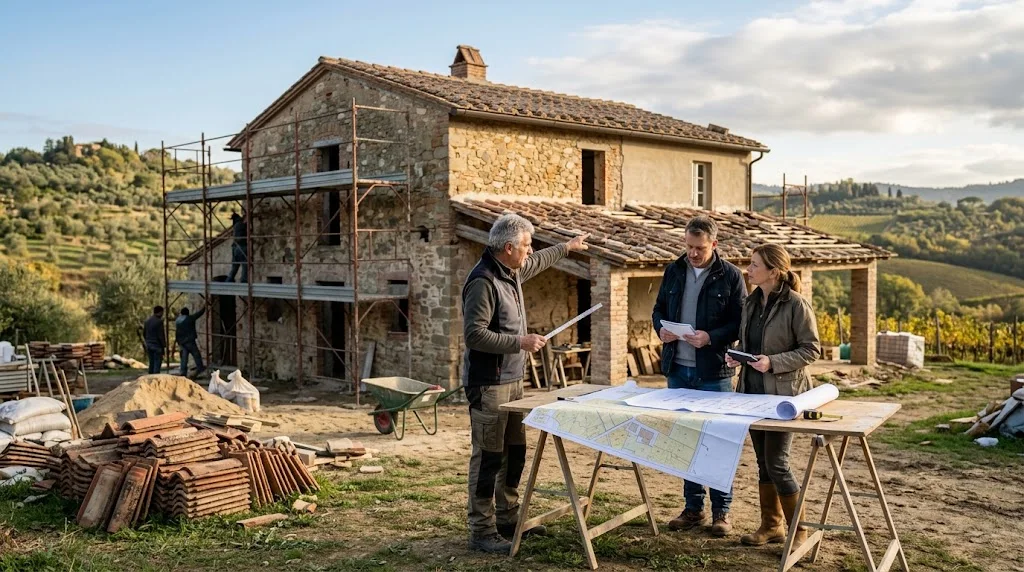
The romantic image of a rustic Italian farmhouse, a casale, waiting to be lovingly restored draws countless foreign buyers every year, and the appeal is genuinely well-founded. What’s less consistently understood before signing is what the renovation itself actually involves: realistic costs, timelines that regularly extend beyond initial estimates, and a permit process considerably more involved than renovating a standard house in the US or UK.
Starting With a Geometra Assessment
Before any renovation planning begins, engaging a geometra, Italy’s licensed building surveyor, to conduct a full structural and legal assessment of the property is the essential first step. The geometra evaluates structural condition, confirms the building’s actual state matches its official cadastral records, and identifies what permits the intended work will require, information that directly shapes both your realistic budget and timeline before you commit further resources. Professional standards and registration for geometri are overseen by their national professional council, worth verifying directly when selecting who to hire for this critical first assessment.
Realistic Renovation Costs
| Renovation Scope | Typical Cost per Square Meter |
|---|---|
| Light cosmetic renovation (systems intact) | Roughly EUR 400-700 |
| Moderate renovation (updated systems, some structural work) | Roughly EUR 700-1,200 |
| Full restoration (structural, systems, roof, everything) | Roughly EUR 1,200-2,000+ |
Most genuine farmhouse restoration projects, particularly for properties that have sat abandoned or minimally maintained for years, fall into the moderate-to-full restoration category, meaning a 200-square-meter casale can realistically require anywhere from EUR 140,000 to well over EUR 400,000 to bring to a genuinely comfortable, modern standard, a figure that regularly surprises buyers who budgeted based on the property’s low initial purchase price alone.
What Drives Costs Higher Than Expected
- Structural surprises discovered once walls or floors are opened, genuinely common in older stone and masonry construction where visible condition doesn’t always reflect what’s underneath.
- Roof replacement, frequently necessary in genuinely neglected properties and one of the more expensive single line items in a full restoration.
- Bringing electrical and plumbing systems up to current code, particularly in properties with decades-old or entirely absent modern infrastructure.
- Access difficulty for rural properties, where getting materials and equipment to a remote farmhouse adds real logistical cost compared to an urban renovation.
The Permit Process
Renovation work in Italy generally requires one of several permit types depending on scope: simpler cosmetic work may only need a CILA (Comunicazione di Inizio Lavori Asseverata), a self-certified start-of-work notice; more substantial structural changes require a SCIA (Segnalazione Certificata di Inizio Attività); and significant new construction or major structural alteration requires a full building permit (permesso di costruire). Your geometra determines which category your specific project falls into and prepares the corresponding documentation.
Realistic Timelines
Permit approval alone can take anywhere from a few weeks for simpler CILA-level work to several months for more complex SCIA or full permit applications, particularly in municipalities with heavier administrative loads or properties requiring additional review, such as those in designated historic or landscape-protected zones. Once permits are secured, actual construction for a full farmhouse restoration commonly runs 12-24 months, sometimes longer, depending on scope, contractor availability, and how many unexpected issues surface once work begins.
Working With Contractors: What to Verify
Confirm any contractor’s registration and insurance status before signing a contract, and request detailed, itemized quotes rather than a single lump-sum figure, since itemization makes it considerably easier to track scope changes and cost overruns as the project progresses. Getting multiple quotes for a significant restoration project, rather than accepting the first contractor recommended, is standard practice and genuinely worth the additional time it takes. Business registration status for any contractor can be independently verified through Unioncamere, Italy’s union of chambers of commerce.
Renovation Incentives Worth Checking
Depending on the specific work involved, standard renovation bonuses (currently 50% for primary residences, 36% for second homes in 2026), the Ecobonus for energy efficiency improvements, and the Sismabonus for seismic safety upgrades may all apply to portions of a farmhouse restoration project, meaningfully offsetting total cost for owners who are Italian taxpayers. Confirming eligibility for these incentives before finalizing your renovation scope, since some require specific technical standards to qualify, is worth doing with a commercialista alongside your geometra. Structuring the renovation in phases that align with each incentive’s specific technical requirements, rather than treating the incentive as an afterthought, can meaningfully change both the total eligible deduction and the sequencing of the work itself.
Living Through the Renovation vs Waiting It Out
Some buyers choose to live nearby, in a rental or a partially finished section of the property, through the renovation process, while others wait it out from abroad, relying entirely on their geometra and contractor to manage the project. Both approaches work, but remote management genuinely requires more trust in your local team and more structured communication, regular photo updates, scheduled video calls, to avoid the frustration of discovering problems only after they’ve compounded.
Read Also: Italy Digital Nomad Visa 2026: Eligibility & Income Proof
Frequently Asked Questions
How much does it really cost to renovate an Italian farmhouse?
Commonly EUR 700-2,000+ per square meter depending on the renovation’s scope, meaning a full restoration of a mid-sized farmhouse often runs into the hundreds of thousands of euros, well beyond what the low purchase price alone might suggest.
How long does a full farmhouse restoration typically take?
Often 12-24 months for construction alone, on top of permit approval time that can run from a few weeks to several months depending on project complexity and municipal processing speed.
Do I need a permit for cosmetic-only renovation work?
Generally yes, even lighter renovation work typically requires at minimum a CILA notification, though the process is simpler and faster than for structural or major renovation work.
Planning With Realistic Numbers From the Start
Treat the purchase price and the renovation budget as two entirely separate figures from the very beginning of your search, and build in a genuine contingency, commonly 15-20% above the initial estimate, for the structural surprises that are genuinely common in older rural Italian construction. Current renovation incentive rates are published by the Agenzia delle Entrate, Italy’s tax authority, and professional standards for geometra and architect work are overseen by their respective national professional bodies, worth confirming directly when selecting your project team.