
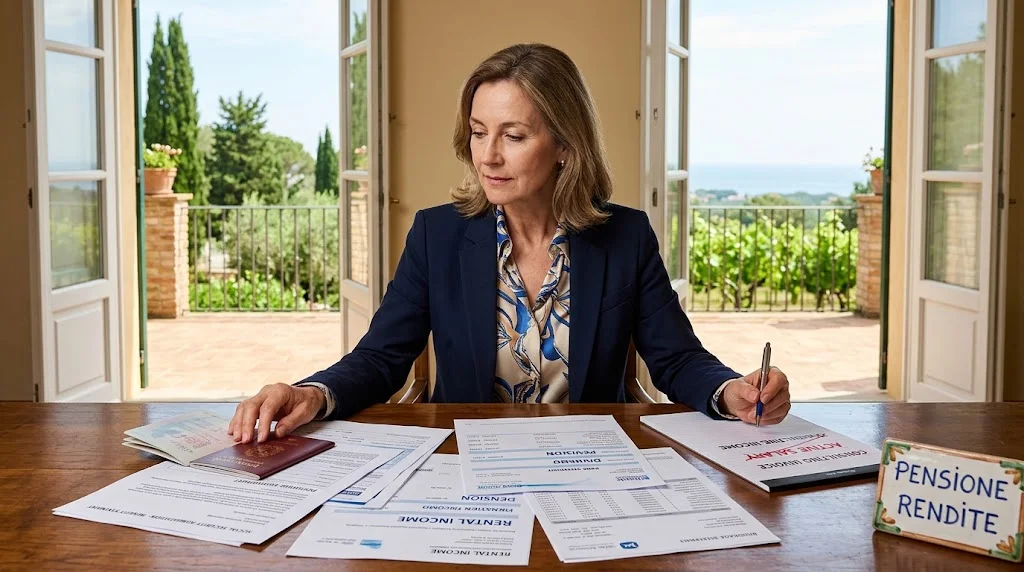
Elective Residency Visa Italy: What Actually Counts as ‘Passive Income’
Table of Contents
- The Core Rule: Income Must Come From Assets, Not Effort
- Income Sources Consulates Generally Accept
- Income Sources That Get Applications Rejected
- The Gray Areas That Cause Real Confusion
- How to Document Passive Income Convincingly
- What Happens If Your Income Mix Includes Some Active Sources
- Frequently Asked Questions
- Does a pension count as passive income for the Elective Residency Visa?
- Can I include rental income if I manage the property myself?
- What happens if my income includes both passive and active sources?
- Do consulates want to see bank statements or just proof of income entitlement?
- Timing Your Application Around Your Income History
- Building a File That Withstands Scrutiny
The Elective Residency Visa hinges entirely on one term consulates use constantly but rarely define with precision: passive income. Applicants who misjudge what qualifies, or who submit a technically true but poorly documented income picture, are among the most common rejections in this visa category, and the distinction between passive and active income is stricter than most first-time applicants expect.
The Core Rule: Income Must Come From Assets, Not Effort
Passive income, for the purposes of this visa, generally means income generated by assets or entitlements you already hold, rather than income generated by ongoing work, effort, or active decision-making on your part. This distinction sounds abstract until you apply it to specific income types, at which point it becomes considerably clearer which sources qualify and which don’t. It’s worth noting this standard is applied by individual consular officers reviewing each file, which means the same underlying income structure can occasionally be assessed slightly differently depending on how clearly it’s presented and documented, one more reason thorough, unambiguous paperwork matters more here than in many other visa categories.
Income Sources Consulates Generally Accept
- Government and private pensions, the most straightforward and consistently accepted category.
- Social Security or equivalent state retirement benefits from your home country.
- Dividends from stocks and investment portfolios you hold, provided they’re demonstrably recurring rather than a one-time distribution.
- Rental income from property you own, where you’re not actively managing tenants or operations day to day.
- Interest income from savings, bonds, or fixed-income investments.
- Trust distributions, where you’re a beneficiary rather than an active trustee managing the underlying assets.
Income Sources That Get Applications Rejected
Consulates consistently reject applications built on salary, wages, active self-employment income, freelance income, or business profits, even when that income is earned entirely outside Italy and has nothing to do with Italian clients or employers. The reasoning is straightforward from the consulate’s perspective: if you’re still actively working to generate the income, you’re not demonstrating the self-sufficient, non-working retirement lifestyle this specific visa category is designed for, regardless of where that work happens to be performed.
The Gray Areas That Cause Real Confusion
Some income types sit closer to the boundary and require more careful documentation:
- Rental income from a property you actively manage yourself, handling bookings, maintenance and tenant relations directly, can read as more active than passive to a skeptical reviewer, compared to rental income managed through a property management company.
- Royalties from past creative or intellectual work, a book, a patent, music, generally qualify as passive since the underlying work was completed in the past, but ongoing royalty-generating activity can complicate that classification.
- Business ownership where you’re not personally operating the business, receiving distributions as a passive investor rather than an active manager, occupies a genuinely gray area that benefits from clear, well-documented separation between ownership and active management.
When in doubt, err toward over-documenting the passive nature of any income source that isn’t a straightforward pension or dividend payment, including a written explanation of exactly how the income is generated and your specific level of ongoing involvement, or lack of it.
How to Document Passive Income Convincingly
| Income Type | Typical Supporting Documents |
|---|---|
| Pension | Official pension provider statements, award letters |
| Social Security/state benefits | Official benefit statements or award letters |
| Dividends | Brokerage statements showing recurring dividend history |
| Rental income | Lease agreements, property management statements, bank deposits matching rental amounts |
| Interest income | Bank or bond statements showing recurring interest payments |
Across every income type, consulates generally want to see the income actually landing in your bank account consistently over time, not just contractual entitlement to it. Several months, ideally closer to a year, of bank statements showing the income arriving as expected is considerably more persuasive than a single official document asserting the income exists.
What Happens If Your Income Mix Includes Some Active Sources
If your income genuinely includes both passive and active components, a pension alongside occasional consulting income, for instance, this visa category becomes considerably riskier. Consulates who identify active income in your file can question the entire application’s legitimacy, since the visa’s basic premise is that you won’t be working in any capacity. In this situation, seriously evaluate whether the Digital Nomad Visa, which explicitly permits work, might actually be the more honest and compliant fit, even if the passive portion of your income alone would technically meet the Elective Residency threshold.
Read Also: Digital Nomad Visa vs Elective Residency: Which Italian Visa Actually Fits Remote Workers
Frequently Asked Questions
Does a pension count as passive income for the Elective Residency Visa?
Yes, pensions are among the most straightforwardly accepted passive income sources for this visa category, requiring only standard official statements or award letters as documentation.
Can I include rental income if I manage the property myself?
Generally yes, though self-managed rental income can face more scrutiny than professionally managed rental income. Clear documentation showing the arrangement is worth including regardless.
What happens if my income includes both passive and active sources?
This meaningfully increases application risk, since the visa’s core premise is the absence of work. Consider whether the Digital Nomad Visa, which explicitly permits work, better fits your actual income situation.
Do consulates want to see bank statements or just proof of income entitlement?
Both, but bank statements showing the income actually and consistently arriving in your account over several months carry more weight than documentation of entitlement alone.
Timing Your Application Around Your Income History
Because consulates weigh recent, consistent income patterns more heavily than a single point-in-time snapshot, timing your application to follow a period of genuinely stable, well-documented passive income strengthens your file considerably. Applicants who’ve recently shifted their portfolio, moved from active employment into retirement, or restructured how their rental properties are managed, benefit from waiting until the new arrangement has produced several months of consistent, bank-verified income before applying, rather than applying immediately on the strength of a recent change alone.
Building a File That Withstands Scrutiny
Treat every income source in your application as something that needs to be explained, not just listed. For anything beyond a straightforward pension, include a brief written explanation of exactly how the income is generated and your level of ongoing involvement, and back every source with several months of consistent bank statements. Current visa category requirements and application guidance are published on the Ministry of Foreign Affairs’ official visa portal, and consulate-specific documentation expectations are available through the Ministry of Foreign Affairs’ consular services pages.